Rat Pest Control in Stevenage | Nex Pest Control
Professional Rat Control Services in Stevenage
Rats are highly adaptable pests that often infest lofts, kitchens, gardens, drains, and wall cavities. They reproduce quickly, meaning a small issue can escalate into a large infestation within weeks.
At Nex Pest Control, we deliver comprehensive rat control solutions tailored to properties in Stevenage, including residential homes, rental properties, restaurants, offices and warehouses.
Our service includes:
Full property inspection
Identification of entry points and nesting sites
Safe and effective rat treatments
Proofing and prevention advice
Follow-up visits where required
We focus on eliminating the current infestation and preventing future problems.
Book a professional rat inspection today.
Property Types We Treat – Rat Control
| Property Type | Service offered |
|---|---|
| Detached Properties | ✅ Yes |
| Semi-Detached Properties | ✅ Yes |
| Terraced Properties | ❌ No |
| External Rat Infestations (rats living on site) | ✅ Yes |
Our specialist outside-in rat control service is available for detached and semi-detached properties, as well as external rat infestations where rats are living or nesting on site.
We do not currently undertake rat control treatments for terraced properties.
External Rat Infestations – Important Information
We only undertake external rat control where there is evidence that rats are living, nesting or burrowing within the property boundaries.
We do not treat rats that are simply passing through gardens from neighbouring properties or other off-site locations.
This is because attempting to intercept rats travelling through a garden, without addressing their nesting sites or the source of the infestation, generally has a limited chance of long-term success.
Our approach focuses on identifying and treating the source of rat activity rather than targeting rodents that are only passing through.
By applying these criteria, we can concentrate on treatments where there is a greater likelihood of achieving effective, lasting results.
Signs You May Have Rats in Your Property
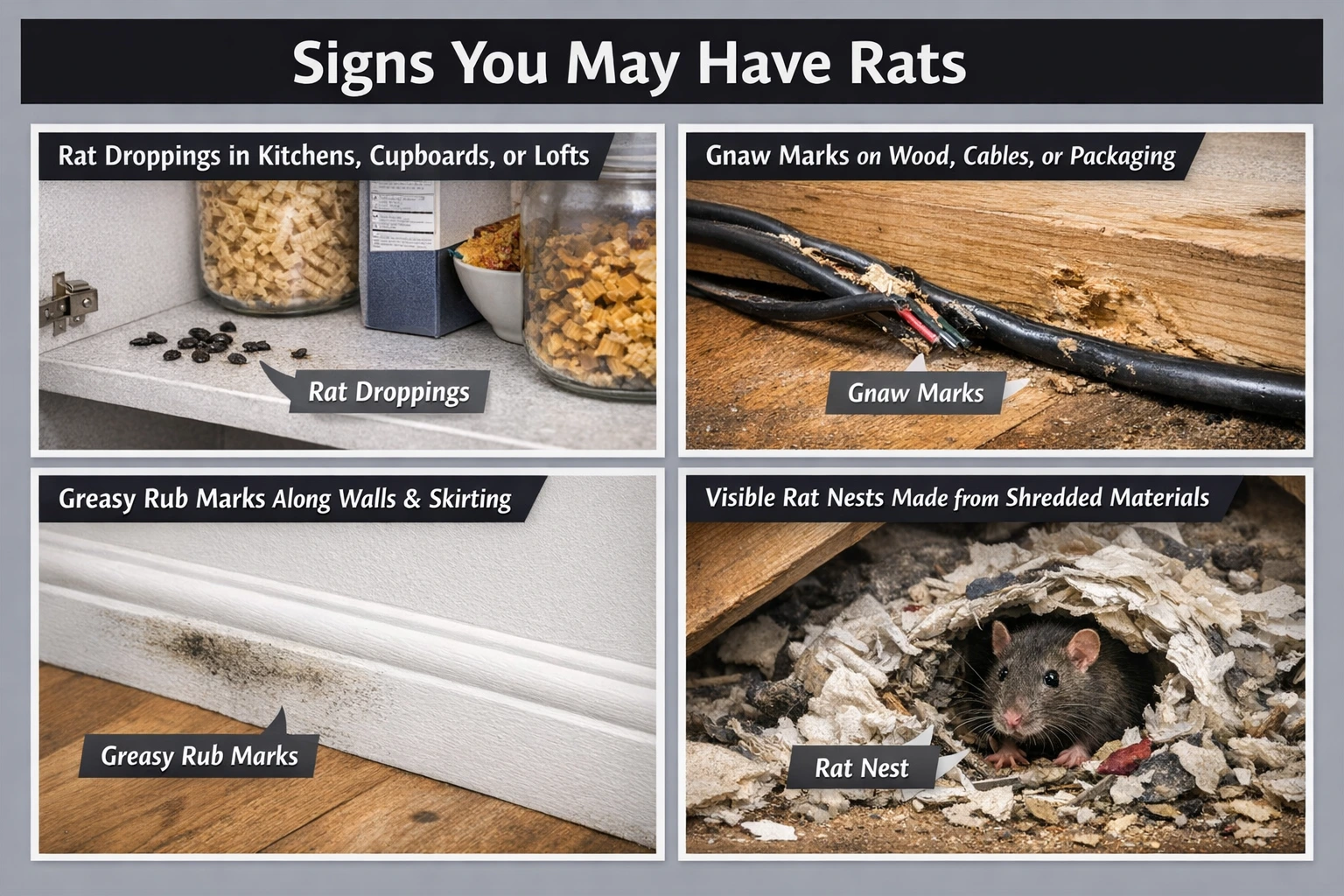
Many homeowners first notice rats when they hear scratching sounds or see droppings. Early detection can prevent serious damage.
Common signs of rats include:
Scratching noises in walls or lofts (especially at night)
Rat droppings around food storage or cupboards
Gnawed wires, pipes, or wood
Greasy smear marks along walls
Burrows or holes in gardens
Strong ammonia-like odours
If you notice any of these warning signs, contact Nex Pest Control immediately for expert rat removal in Stevenage.
📞 Speak with a pest control specialist today 01438 870688
Why Rats Are a Serious Problem
Rats are more than just an unpleasant nuisance. They present significant health and safety risks.
Rats can:
Spread diseases such as Leptospirosis
Contaminate food and surfaces
Chew through electrical wiring (fire risk)
Damage insulation and structural materials
Multiply rapidly within properties
Professional pest control ensures the infestation is handled safely and completely.
Our Outside-In Rat Control Process
Identifying the Cause Before Treating the Infestation
At Nex Pest Control, our rat control process is based on a fundamental principle:
Removing rats without addressing how they entered the property may only provide a temporary solution.
Rather than immediately deploying traps or rodenticides, we begin by investigating the external structure of the building and, where necessary, the underground drainage system.
Our objective is to establish how rats are accessing the property and eliminate those routes before progressing to the removal of the existing infestation.
This investigative approach helps us address the underlying cause rather than simply treating the symptoms.
Our process consists of five stages.
Stage 1 – External Property Investigation and Rat Entry Point Identification
Finding out how rats are entering your property.
Our investigation begins outside the building.
We examine accessible areas of the property’s external structure, looking for defects and vulnerabilities that could allow rats to gain entry.
Rats are capable of exploiting relatively small openings, particularly where damaged materials can be enlarged through gnawing.
We investigate potential access points including:
External Brickwork and Mortar Joints
Damaged masonry, missing mortar and gaps within the building’s external structure can create opportunities for rodents to enter concealed voids.
Air Bricks and Ventilation Openings
Damaged or inadequately protected ventilation openings may provide access beneath suspended floors or into internal cavities.
External Pipework Penetrations
Gaps surrounding water supplies, waste pipes and other services entering a building are common areas requiring investigation.
Foundations and Ground-Level Defects
Openings around the base of a property may allow rats to access subfloor spaces or concealed areas beneath the building.
Rooflines, Extensions and Adjoining Structures
Rats can climb and may exploit openings around roof junctions, extensions, eaves and connected buildings.
Drainage Connections and Inspection Chambers
Drainage infrastructure is also assessed for evidence suggesting rats may be entering through underground pipework.
During the investigation, we look for supporting evidence such as droppings, gnaw marks, burrows, grease marks and established movement routes.
The purpose of this stage is to identify the routes rats are using before deciding on the most appropriate control measures.
Stage 2 – Underground Drainage Investigation and CCTV Surveys
Investigating hidden rat entry routes beneath your property.
Not every rat infestation originates from a visible defect in the external structure.
In some properties, rats gain access through damaged underground drainage systems.
Rats are capable swimmers and can travel through sewer networks. Where defects exist within the drainage infrastructure, they may exploit these openings to escape into surrounding ground, building foundations or concealed voids.
Potential drainage defects include:
Fractured underground drainage pipes.
Displaced or damaged pipe joints.
Redundant drainage connections.
Incorrectly sealed pipework.
Open connections within drainage infrastructure.
Collapsed or deteriorating drainage sections.
These defects can be particularly difficult to identify because they are concealed underground.
Where evidence suggests the drainage system may be contributing to an infestation, Nex Pest Control can undertake a professional CCTV drain inspection.
Using specialist camera equipment, we investigate accessible sections of the underground drainage system to identify structural defects and potential rodent access routes.
CCTV Drain Inspections
A CCTV drain inspection allows us to investigate pipework without automatically requiring excavation.
The inspection can help establish whether drainage defects are creating a route for rats to enter the property.
Where defects are identified, we can recommend appropriate corrective measures.
Rat Blocker Supply and Installation
Where suitable, a specialist rat blocker may be installed within the drainage system.
These mechanical devices are designed to help prevent rats travelling upstream through drainage pipes while allowing wastewater to flow in the intended direction.
Rat blockers must be correctly selected and installed in suitable locations.
Importantly, a rat blocker does not repair damaged drainage infrastructure. Where defective pipework is responsible for an infestation, appropriate repairs may also be required.
Our objective is to identify and address the underground access route rather than repeatedly treating rats entering through the same drainage defect.
Stage 3 – Structural Rat Proofing and Entry Point Elimination
Securing the property before removing the rats.
Once the relevant access routes have been identified, our next priority is to eliminate them.
This is one of the most important stages of our outside-in approach.
Rather than leaving structural defects untreated while attempting to remove the infestation, we prioritise preventing additional rats from entering.
Depending on the findings, appropriate proofing measures may include:
Sealing accessible openings around external pipework.
Installing suitable rodent-resistant proofing materials.
Protecting vulnerable ventilation openings.
Addressing accessible defects in external brickwork.
Securing identified ground-level access points.
Installing suitable drainage protection devices.
Recommending specialist structural or drainage repairs where required.
Proofing materials and installation methods are selected according to the location, construction and function of the affected area.
Essential ventilation and drainage functions must be maintained.
Why do we proof the property before removing the rats?
Because removing the existing rodents without securing their entry routes leaves the property vulnerable to further infestation.
By addressing the identified access points first, we aim to prevent additional rats entering while the remaining population is being controlled.
Where immediate proofing is unsuitable or could create additional risks, the sequence of work is adapted accordingly.
Our priority remains identifying and eliminating the source of the infestation wherever practicable.
Stage 4 – Professional Rat Removal and Targeted Treatment
Removing rats already present inside the property.
Once the identified entry routes have been secured, we progress to controlling the remaining infestation.
At this stage, the property should be better protected against additional rats entering through the access routes already addressed.
Depending on the circumstances, we may use professional trapping equipment or other appropriate rodent control methods.
Treatment selection takes account of:
The extent of the infestation.
The location of rat activity.
Accessibility of affected areas.
The presence of children and pets.
Risks to wildlife and other non-target animals.
The suitability of different control methods.
Where rodenticides are appropriate, they are used in accordance with their authorisation, product instructions and relevant professional guidance.
Our objective is to remove the remaining rats efficiently while minimising unnecessary risks to people, pets and wildlife.
By combining physical exclusion with targeted population control, we aim to resolve the existing infestation and reduce the likelihood of further entry.
Stage 5 – Monitoring, Follow-Up and Long-Term Prevention
Confirming that the infestation has been controlled.
Rat control does not necessarily end after the initial treatment.
Where required, follow-up visits allow us to assess whether rodent activity has reduced or ceased.
Monitoring may involve:
Checking trapping equipment.
Assessing evidence of continuing activity.
Reviewing previously identified entry points.
Investigating any remaining signs of infestation.
Recommending further proofing where necessary.
If activity continues, additional investigation may be required to identify overlooked or inaccessible entry routes.
We also provide practical advice on reducing environmental conditions that may attract rodents.
Our aim is to combine effective removal with preventative measures that provide lasting protection.
Why Our Outside-In Approach Is Different
We Focus on the Cause, Not Just the Rats
Many recurring rat infestations are associated with unresolved access routes.
A property may undergo repeated trapping or rodenticide treatments, but if the building remains accessible, additional rats can continue to enter.
Consider two common examples.
Example 1 – Rats Entering Through Damaged Brickwork
Rats enter a property through an opening around external pipework.
The rats inside are removed, but the opening remains untreated.
Additional rats may subsequently exploit the same route.
Our approach prioritises identifying and securing the opening before completing the removal process.
Example 2 – Rats Entering Through a Defective Drain
Rats access the area beneath a property through a fractured underground drainage pipe.
Repeated treatments may remove individual rodents, but the drainage defect remains.
Unless the underlying problem is addressed, the property may remain vulnerable to further infestations.
A CCTV drain inspection can help identify the defect and establish what corrective measures are required.
Why Rat Infestations Keep Coming Back
Recurring rat infestations can be associated with:
Structural openings that have not been identified.
Inadequate rodent-proofing materials.
Defective underground drainage.
Unsealed pipework penetrations.
Inaccessible building voids.
Additional entry routes that remain undiscovered.
Repeated rat activity does not automatically mean a previous treatment was ineffective.
It may indicate that the underlying access route was never eliminated.
Our outside-in approach is designed to investigate and address these vulnerabilities, reducing the likelihood of repeated infestations.

Drain Related Rat Problems and Sewer Entry Points
Many rat infestations in UK homes originate from the underground drainage system. Rats are strong swimmers and regularly travel through sewer networks searching for food sources and shelter. If there is damage to a pipe, a faulty joint, or an open connection within the drainage system, rats can escape from the sewer and gain access to properties through pipework, cavity walls, or beneath floors.
Identifying these hidden entry points is an important step in solving persistent rat problems. A professional CCTV drain inspection allows technicians to survey the internal condition of your drainage system using specialist camera equipment. This inspection can reveal cracked pipes, displaced joints, collapsed sections, or other defects that may be allowing rats to enter from the sewer network.
Once the source of the problem has been identified, preventative measures can be installed to stop rats travelling through the drainage system in the future. One of the most effective long-term solutions is the installation of a rat blocker. This involves fitting a stainless steel non-return valve inside the inspection chamber which allows wastewater to flow normally while preventing rats from moving upstream through the drains towards your property.
By combining professional rat control with proper drainage protection, Nex Pest Control can help eliminate the current infestation while significantly reducing the risk of rats returning through the sewer system.
Why Choose Nex Pest Control in Stevenage?
Residents trust Nex Pest Control because we provide:
✔ Fast response times
✔ Local pest control expertise
✔ Discreet and professional service
✔ Safe treatments for families and pets
✔ Long-term pest prevention solutions
We understand the pest issues that affect properties in Stevenage and the surrounding Hertfordshire area, allowing us to provide highly effective solutions.
Get a professional rat control quote today 01438 870688.
Rat Control for Homes and Businesses
We provide rat control for:
Residential properties
Letting agents and landlords
Restaurants and cafés
Offices and commercial premises
Warehouses and industrial units
If your business requires discreet pest control services, Nex Pest Control can arrange flexible treatment times and ongoing pest management plans.
Areas We Cover Near Stevenage
Our rat pest control services also cover nearby areas including:
Knebworth
Hitchin
Letchworth Garden City
Welwyn Garden City
If you’re located nearby and need urgent rat removal, contact Nex Pest Control today.
Get Fast Rat Control in Stevenage
If you suspect rats in your property, the sooner action is taken, the easier the infestation is to control.
Nex Pest Control provides rapid, professional rat control services across Stevenage and Hertfordshire.
Call now to book an inspection 01438 870688
Request a free quote online
Speak to a pest control expert today
Call or Message Us
If you need urgent rat pest control, the fastest way to reach us is by phone or WhatsApp.
📞 Call Us
01438 870688 – Stevenage Office
01462 374030 – Hitchin Office
Client Reviews & Feedback
We are a small family run business of dedicated Pest Controllers that take great pride in our work.
Where we work
- Stevenage
- Hitchin
- Letchworth
- Baldock
- Welwyn Garden city
- Ware
- Hertford
Where we work (Bird control)
- Hertfordshire
- Bedfordshire
- Cambridgeshire
- Essex
- Buckinghamshire
- Northamptonshire
- Peterborough
- Greater London
- Kent
